


 10th Aug, 2026
Auto Detailing Calgary: How Paint Correction Fixes Swirl Marks
Go stand next to your car on a sunny Calgary afternoon and look at the hood at an angle. Do you see that spiderweb of fine scratches catching the light? Annoying, isn’t it?
You’ve probably already tried the obvious fixes – a good wash, a coat of wax, or maybe even one of those “scratch remover” pens from the auto parts store. And yet, there they are, staring back at you every time the sun hits just right.
Here’s the part nobody tells you at the car wash: those marks aren’t dirt. You can’t wipe them away. They’re physical grooves cut into your clear coat, and honestly, every drive-thru wash you’ve used has probably added a few more.
So let’s talk about why quick fixes keep failing you – and what auto detailing in Calgary can actually do to make swirl marks disappear for good.
What Causes Swirl Marks on Your Vehicle, Anyway?
Swirl marks are microscopic scratches sitting in the top layer of your clear coat. Light hits those tiny ridges and bounces around instead of reflecting cleanly back at you. That’s the hazy, spiderweb look you’re seeing. They’re not sitting on your paint. They’re carved into it.
And if you live in Calgary, your paint is fighting an uphill battle. How? Let’s see.
• Automatic Brush or Tunnel Car Washes: These spinning brushes have touched hundreds of dirty cars before yours. Every pass drags grit across your panels like sandpaper.
• Winter Road Salt and Gravel Dust: It gets trapped in your wash mitt without you noticing. Then it gets rubbed right back into the paint during your “gentle” hand wash.
• Wiping Down A Dry Car: This feels harmless, but it’s not. Dust and grit just get dragged across the surface instead of lifted off.
• The One-Bucket Method: If you’re dunking the same mitt back into the same soapy water the whole time, you’re basically recirculating dirt onto your own paint.
None of these feel like a big deal in the moment. But after a few Calgary winters? They add up fast, even on a car you wash religiously. If you’re nodding along to two or more of those, that’s probably where your swirl marks came from.
Discover the top 3 kinds of car scratches that shouldn’t be ignored.
Quick Fixes vs. Real Solutions: 3 Approaches, Compared
Once you notice swirl marks, you’ll usually land on one of three roads. Let’s walk through them honestly.
Approach A: Fillers, Glazes & Waxes
These are cheap, fast, and the shine shows up almost instantly. But the catch is that these products don’t remove the scratch; they fill it. Oils and polymers sit in the groove and trick the light for a week or two. Then it rains, or you hit a car wash, and the swirls are back like nothing happened. Because nothing did.
Approach B: DIY Hand Buffing
The best thing about this approach is that it is accessible with no requirement of any special gear. Your hand can’t apply consistent pressure the way a machine can. You’ll level some scratches, completely miss others, and never generate the mechanical cut a modern clear coat actually needs.
Approach C: Professional Machine Paint Correction
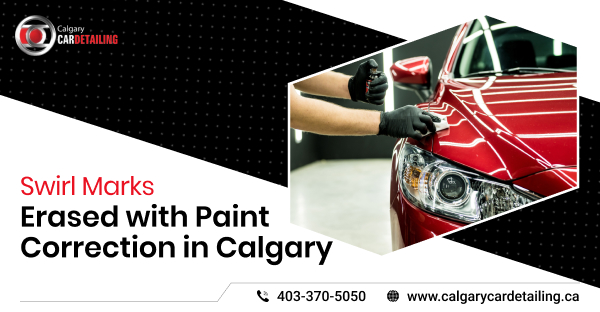
This is the one that actually works. It physically levels the clear coat around the scratch instead of masking it, bringing back real, mirror-deep gloss. It takes specialized machine polishers, trained hands, and a careful multi-stage process.
This isn’t a Saturday-afternoon project – and honestly, that’s exactly why it works. Fillers hide the problem. Correction removes it. Only one of those survives your next car wash.
How Professional Paint Correction Actually Erases Swirl Marks
Curious what’s actually happening once your car goes in the bay? It’s not one quick pass with a buffer. It’s a controlled sequence, built to remove exactly as much clear coat as needed and not a hair more.
Step 1 – Chemical & Mechanical Decontamination
First, old wax and sealant get stripped off completely. Think of it as clearing the table before the real work starts. An iron remover pulls embedded brake dust and metal particles out of the paint, and a clay bar lifts the stubborn stuff like tar, tree sap, and overspray that no wash, ever, could touch.
Step 2 – Paint Gauge Inspection & Surface Mapping
Next comes a digital paint depth gauge, measuring clear coat thickness panel by panel. Now, why does this matter to you? Because it sets the safe limit for how much correction your car can actually handle, especially important on factory-thin coats where there’s zero room for guesswork.
Step 3 – Multi-Stage Machine Correction
This is the heart of the process. Mild hazing usually needs just a 1-stage correction: a single, focused polish pass. Deeper swirl marks call for 2-stage correction. This involves a heavier compound to cut through the damage, followed by a micro-finishing polish with dual-action polishers that bring the surface back to a glass-like finish.
Step 4 – Panel Wipe Down & Final Inspection
An isopropyl alcohol wipe clears away polishing oils that can hide leftover imperfections. Then your car gets inspected under specialized LED light arrays, the exact kind of raking light that exposed your swirl marks in the first place. If a scratch survived, this is where it gets caught.
Explore the 5 things professional car detailers wish every customer knew.
Protecting Your Corrected Paint in Calgary
Freshly corrected paint is more vulnerable than it’s been in years. That old wax layer that used to buffer against UV rays, gravel, and road salt? That gets stripped away in Step 1. So what now?
• Ceramic Coating: This is a hydrophobic layer that bonds directly to your corrected surface, locking in that deep gloss while adding genuine UV resistance. It makes every future wash noticeably easier.
• Paint Protection Film (PPF): It is a physical, self-healing shield for your high-impact zones – hood, front bumper – that absorbs rock chips and highway gravel before they ever reach your fresh paint.
Correcting your paint without protecting it afterward is a bit like repainting your fence right before a hailstorm. Don’t skip this part.
Restore Your Vehicle’s Finish with Premier Auto Detailing in Calgary
Swirl marks were never a cleanliness problem. They’re permanent damage sitting in your clear coat, and no filler, glaze, or quick wax is going to change that fact. The only thing that actually works is mechanical correction that levels the paint itself and gives you back the finish your car had rolling off the lot.
Go take one more look at that hood in the sun. If it’s hazier than you’d like, don’t mask it – correct it. The specialists for auto detailing in Calgary can inspect your paint, map out the right correction stage for your car, and get your finish back to true, factory-fresh gloss.
Schedule your paint inspection with Calgary Car Detailing today and see the difference real correction makes.