


 09th Oct, 2026
How Car Detailing Calgary Makes Your Paint Pop with Buffing & Polishing
Wait for a sunny afternoon, crouch down next to your hood, and look along the surface. See those fine circles and spiderweb lines? Most Calgary drivers spot them eventually, and usually right after paying for a wash.
A wash won’t fix it, and wax only covers it for a couple of weeks. What does work is car detailing that takes the damage out of the paint. At Calgary Car Detailing, we do that with machine buffing and multi-stage polishing. The good news is that this kind of damage sits in the top layer of the paint, so it can be corrected. We’ll walk you through how it works.
What Calgary Does to Your Clear Coat
Our roads are rough on paint, mostly in boring ways. Gravel on Deerfoot, the sand and salt mix that sits on the roads from November to April, and one too many trips through a brush wash. Each one does its own damage:
• Gravel chips and cracks the clear coat, and moisture gets in through those chips
• Salt and brine cling to the paint and speed up oxidation, and our freeze-thaw swings don’t help
• Brush washes drag trapped grit across the surface, which is how swirl marks get started
Nobody notices it happening because it builds up slowly. Then one day you park next to a new car and the difference is obvious.
Clear coat is meant to be smooth, close to glass. A scratch is a tiny groove, and light that hits it bounces off sideways. Add up thousands of them, and the paint looks flat and a bit grey. The colour underneath is usually fine. The surface on top just can’t reflect light properly anymore.
Explore the benefits of installing a self-healing paint protection film.
Polishing and Buffing Aren’t Quite the Same Job
Plenty of shops use both words as if they mean one thing. You need both, in order, and any decent Calgary car detailing team will work that way.
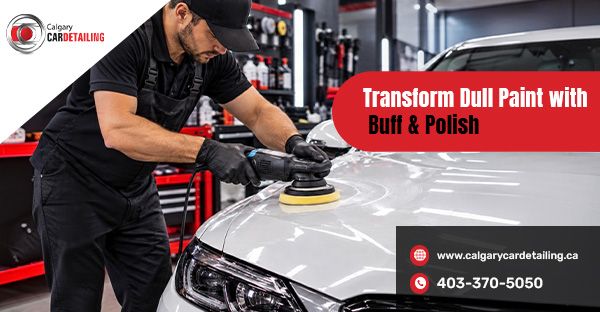
Polishing comes first. Fine abrasives shave down the sharp edges around each scratch until it’s too shallow to catch the light. Nothing gets filled in or covered up.
Buffing is the finishing pass. We use a rotary or orbital machine with a pad chosen for your particular paint, and the friction clears away leftover haze. Pad choice is a big deal. Too aggressive and you’ve cut through the clear coat you can’t put back. Too soft and you’ve spent an hour changing nothing.
So why not just hand wax it? A few reasons:
• Wax fills scratches, so they return once it wears off.
• Hands press unevenly, so the hood looks great and the door still looks tired.
• It can’t fix oxidation that’s already in the clear coat.
• A machine treats every panel the same way.
What Happens When You Drop the Car Off
A typical job at our shop goes like this:
1. Chemical decontamination and clay bar.
This lifts off salt, iron fallout, and tar. Skip it, and the buffer grinds that grit straight into your paint.
2. Paint depth reading.
A gauge tells us how much clear coat there is to work with, so we’re measuring, not guessing.
3. Compounding and refining in stages.
A heavier compound handles the deeper defects, then finer polishes bring up the gloss.
4. IPA wipe.
It strips off the polishing oils, so what you see is the real paint with nothing hiding what’s left.
It all happens indoors in our temperature-controlled facility, so there’s no dust, no sun-heated panels, and no January cold interfering with the products. Our technicians are IDA-certified, and the team has been doing this for 15+ years. This experience counts for more than the machines, because the hard part is knowing when to stop taking paint off.
A full correction also isn’t a rush job. Depending on the condition of your paint, it can take a good while, since hurrying any step is how paint gets burned through.
Protect It Straight Away
Freshly corrected paint is bare. One salty commute starts the damage again. This is why protection goes on right after the correction, not next month.
We offer two options, and they handle different problems:
• Ceramic Coating: a hard, slick layer that sheds water and road grime, so winter washes get much easier
• XPEL Paint Protection Film (PPF): clear, self-healing film that takes gravel hits and light scratches so your paint doesn’t have to
They aren’t either-or, either. Plenty of owners put film on the front end, where the gravel lands, and coat the rest. If you’re not sure what fits your car, ask us. It usually comes down to how and where you drive.
Learn the key differences between XPEL paint protection film and ceramic coating.
Come See What Your Paint Can Look Like
Dull paint on a Calgary car is normal, and it’s fixable. Polishing takes the scratches down, buffing brings the clarity back, and a coating or film keeps road damage from undoing the work. You’ll see the difference the first time the sun lands on the hood.
If you want car detailing that actually fixes the paint, or you just want to know what yours needs. Visit Calgary Car Detailing and get a professional’s advice.