


 18th Sep, 2026
XPEL Paint Protection Film vs. Ceramic Coating: Key Differences
Anyone who’s driven Deerfoot in March knows the drill. A gravel truck pulls ahead of you, something pings off the hood, and you spend the rest of the commute wondering how bad it looks.
Then there’s the brine. The slush. The freeze-thaw cycles that swing thirty degrees in a chinook weekend. And come July, UV rays do quiet damage to a clear coat that’s already had a rough winter.
Calgary is genuinely hard on paint. That’s why XPEL Paint Protection Film and professional ceramic coating are the two systems we install most at Calgary Car Detailing.
They’re not competing products, though. They solve different problems. Picking the right one comes down to how and where you actually drive.
Understanding XPEL Paint Protection Film (PPF)
What Is It & How It Works
PPF is a clear, elastomeric polyurethane film. It is roughly 8 to 12 mils thick and gets custom-cut and conformed to your vehicle’s panels. Think of it as body armour. When a rock hits, the film absorbs and disperses the energy instead of letting it crack your clear coat. The paint underneath never knows it happened.
Primary Advantages
• Physical impact defence: Rock chips, flying gravel, sand-blasting, road debris — the film takes the hit so your paint doesn’t.
• Heat-activated self-healing. Light swirl marks and fine scratches disappear on their own with heat from sunlight, warm water, or a heat gun. The topcoat literally reflows.
• Targeted high-impact coverage. Front bumper, hood, fenders, mirrors, rocker panels, and A-pillars take the worst of it. You can protect just those zones, or wrap the full body.
• Invisible protection. Properly installed, the edges are wrapped and tucked. Most people can’t tell it’s there.
Discover the evolution of shine, from Wax to XPEL paint protection film.
Understanding Professional Ceramic Coating
What Is It & How It Works
Ceramic coating is a liquid nano-ceramic polymer that chemically bonds to your clear coat. It fills and seals the microscopic pores in the paint surface, creating a hard, slick, semi-permanent layer.
Primary Advantages
• Extreme hydrophobicity: Water beads and sheets off, taking road grime, mud, and salt film with it.
• Deep, mirror-like gloss: Coatings add optical clarity and depth that paint alone can’t produce.
• UV and oxidation defence: Slows the fading and dulling that Alberta summers cause.
• Effortless washing: Contaminants struggle to bond, so your car cleans up in a fraction of the time.
Direct Comparison: XPEL PPF vs. Ceramic Coating
• Impact resistance
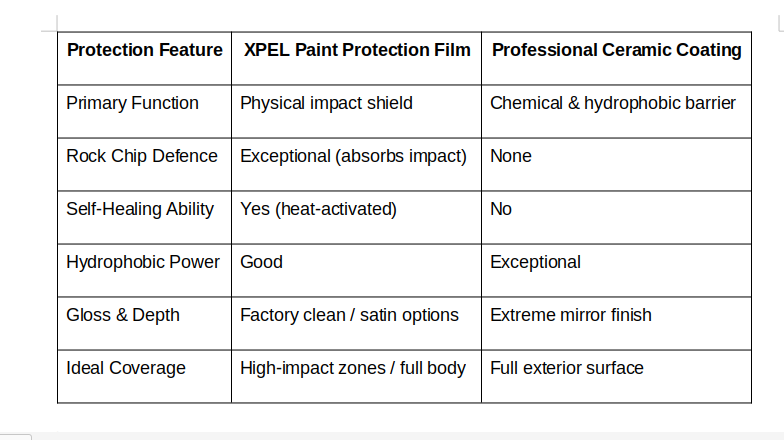
This one isn’t close. PPF is a physical barrier with real thickness and give. Ceramic coating is measured in microns — it offers zero meaningful chip protection. A coated car and an uncoated car chip the same way.
• Surface finish and maintenance:
PPF brings self-healing elasticity, so light marring fixes itself. Ceramic brings glass-like slickness, so dirt struggles to stick in the first place. Different mechanisms, both easier to live with than bare paint.
• Lifespan and durability:
Quality PPF carries multi-year manufacturer warranties covering yellowing, cracking, and delamination. Professional ceramic coatings deliver multi-year hydrophobic performance, though that depends heavily on wash habits and whether you top it up. Ask us for the current warranty terms on the specific product you’re considering.
Feature Comparison Matrix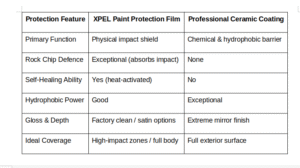
The Calgary Climate Factor: Which Armor Do You Need?
Choose PPF Calgary installs when:
• You commute Deerfoot, Stoney Trail, or Highway 2 daily.
• Your vehicle is new, leased, or high-value and you care about resale.
• Gravel season already left its mark and you don’t want a repeat.
• You want chips eliminated, not just made easier to wash off.
Choose ceramic coating when:
• You park in a garage or underground stall.
• Your driving is mostly city, short-distance, lower-speed.
• You want a car that stays clean with minimal effort.
• Gloss and slickness matter more to you than chip defence.
The Ultimate Defence: Combining Both
Here’s what we recommend most often. Install PPF on the high-impact zones, then apply ceramic coating over the film and across the rest of the vehicle. You get the physical rock chip barrier where the damage actually happens, plus hydrophobic self-cleaning everywhere. The coating also makes the film itself easier to wash and helps it stay clear.
Explore how well XPEL paint protection films can be paired with ceramic coating.
Choose the Right Protection Strategy for Your Car
If impacts are your problem, you need film. If cleaning, gloss, and UV are your problem, you need coating. If you’re driving a nice vehicle through a Calgary winter, you probably want both.
What matters just as much is the install. Surface prep, decontamination, paint correction, and precise film fitment are what separate protection that lasts from protection that peels, hazes, or traps defects underneath. Certified technicians and a controlled install bay aren’t optional here; they’re the whole job.
Ready to sort out which setup fits your vehicle? Contact Calgary Car Detailing for a consultation and paint inspection, or book online and we’ll walk you through your options for XPEL Paint Protection Film in person.