


 05th Jul, 2026
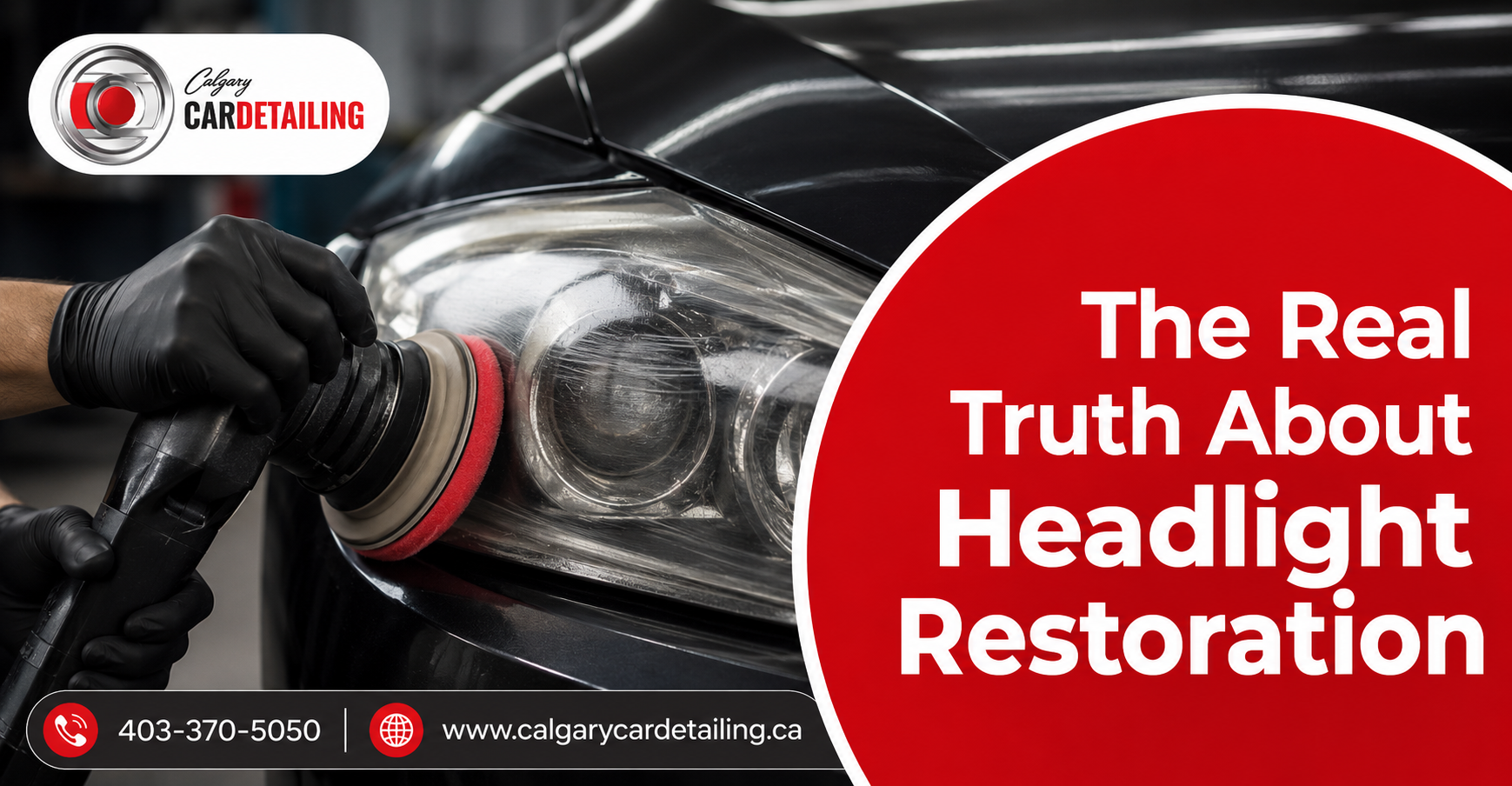
Car Detailing Calgary: The Truth About Headlight Restoration
Picture this. It’s 5:30 PM on a January evening, the sun’s already gone, and you’re merging onto Stoney Trail through a wall of slush kicked up by the semi ahead of you. You flip on your high beams and… nothing changes. Your headlights are throwing out a weak, yellowish glow instead of cutting through the dark.
If you’ve been searching for car detailing in Calgary because your lenses look cloudy, foggy, or downright ancient, you’re not imagining the problem. Oxidized polycarbonate lenses are quietly stealing your visibility. And winter driving is exactly when you can’t afford that.
Scroll social media for five minutes, and you’ll find a dozen ‘hacks’ promising showroom-clear headlights for the cost of a coffee. But the truth is that real restoration isn’t a quick surface wipe. It’s a meticulous, multi-stage process that treats your headlight lens the same way a paint correction treats your clear coat—methodically, and with the right tools.
The Science of the Fog – Why Calgary Cars Have It Worse
Your headlights aren’t glass anymore. Since the late 1980s, automakers have used polycarbonate plastic for lenses because it’s lighter and more impact-resistant than glass. The catch? Polycarbonate isn’t naturally UV-stable.
Every headlight rolls off the factory line with a microscopically thin clear coat designed to block ultraviolet rays. Once that coat breaks down, the plastic underneath starts to oxidize. This is what creates the yellow, cloudy haze you’re seeing.
Calgary accelerates this process in ways drivers in coastal cities never have to think about.
Altitude: Sitting over 1,000 metres above sea level means significantly less atmosphere to filter UV radiation. Your headlights are absorbing more direct ultraviolet exposure every single day than lenses in Vancouver or Toronto.
Road Debris: Gravel trucks, winter sanding programs, and QEII Highway chip-seal all send abrasive particles straight into your front-end plastic. This creates micro-scratches that compromise the factory clear coat and give oxidation more surface area to grab onto.
Calgary headlights are fighting a two-front war: relentless high-altitude sun and constant physical abrasion from the road itself.
The Truth About DIY “Quick Fixes” (Pros and Cons)
Before you reach for what’s under the kitchen sink, let’s break down what these popular methods actually do.
Approach A: The Toothpaste Method
Pros: Mild abrasives can scrub away surface grime and give a quick, temporary shine.
Cons: The same abrasive action strips away whatever remains of your factory UV coat. Without that protective layer, the exposed plastic oxidizes faster than before. This means your headlights often look worse within weeks than they did before you started.
Approach B: The WD-40 or Oil Trick
Pros: Creates an immediate, glossy-looking finish.
Cons: This “fix” is an optical illusion. Oil temporarily fills in micro-scratches, tricking light into refracting more evenly. It does nothing to actually repair the surface, and it washes off the moment you hit rain or drive through a car wash. As a result, this leaves behind a greasy film, that attracts road dust and makes the haze look even dingier.
Approach C: Over-the-Counter Retail Kits
Pros: A legitimate step up from kitchen-cabinet hacks, with more consistent results than toothpaste or oil.
Cons: These kits typically rely on weak, inconsistent hand-sanding and low-grade wipe-on sealants. Under harsh Alberta freeze-thaw cycles and intense UV exposure, this thin sealant layer breaks down fast, often in a single season.
None of these methods address the root problem. They mask it, briefly, and then hand it back to you worse than before.
Discover the top car care mistakes that damage your car without you realizing.
The Professional Solution – The Calgary Car Detailing Method
Mobile detailing and driveway jobs have a built-in ceiling. Inconsistent lighting makes it nearly impossible to judge true clarity, and temperature swings mean protective coatings never cure properly. It is exactly why so many at-home and mobile “restorations” fail within a few months. A controlled, in-shop environment with proper lighting and stable temperature is what makes the results actually last.
Here’s what the full process looks like:
Step 1: Deep Chemical Decontamination:
Before any sanding happens, we strip away embedded iron particles, road tar, and grime that would otherwise get dragged across the lens. These can cause new scratching during correction.
Step 2: Multi-Stage Precision Wet Sanding
Using progressively finer grits, we gradually level the damaged, oxidized layer of plastic. This step is methodical by design. Moving too fast or skipping grits is how DIY sanding jobs end up hazier than when they started.
Step 3: Power Polishing and Compounding
Specialized rotary tools and dedicated plastic-polishing compounds restore true optical clarity. They work the surface back to a genuinely transparent finish rather than a temporary shine.
Step 4: Permanent UV Lockdown
This is the step every DIY method skips entirely. We seal the corrected lens with commercial-grade ceramic coating or XPEL paint protection film, rebuilding the UV barrier your headlights lost years ago. This ensures the oxidation doesn’t just come right back.
Restoration without UV protection isn’t restoration. It’s a temporary delay before the fog returns.
Discover how car detailing services help combat odours, mould, and allergens.
The Ultimate Value Comparison
Pros of Professional Restoration:
Restores up to 80% of lost light output
Dramatically improves nighttime driving safety and visibility
Enhances your vehicle’s resale value
Saves thousands compared to replacing OEM headlight assemblies
Cons:
Requires dropping your vehicle off at a specialized shop rather than a 10-minute driveway fix
For most Calgary drivers, that trade-off isn’t close.
Don’t Gamble on a Five-Dollar Fix
Your headlights are a safety system, not a cosmetic afterthought — and internet shortcuts consistently leave Calgary drivers worse off than when they started. Professional car detailing in Calgary offers real, long-lasting clarity and demands specialized tools, the right environment, and genuine expertise.
Ready to see the road clearly again? Book a standalone headlight restoration or add it to a complete interior/exterior detailing package through our convenient online booking tool at Calgary Car Detailing.